About
About PulseAudio
PulseAudio is a sound server, originally created to overcome the limitations of the Enlightened Sound Daemon (EsounD).
A sound server can serve many functions:
- Software mixing of multiple audio streams, bypassing any restrictions the hardware has.
- Network transparency, allowing an application to play back or record audio on a different machine than the one it is running on.
- Sound API abstraction, alleviating the need for multiple backends in applications to handle the wide diversity of sound systems out there.
- Generic hardware abstraction, giving the possibility of doing things like individual volumes per application.
PulseAudio comes with many plugin modules. All audio from/to clients and audio interfaces goes through modules.
Manuel Amador created a diagram describing how the different parts of PulseAudio play together. (Not all modules are shown.)
PulseAudio clients can send audio to "sinks" and receive audio from "sources". A client can be GStreamer, xinelib, MPlayer or any other audio application. Only the device drivers/audio interfaces can be either sources or sinks (they are often hardware in- and out-puts).
Current Status
The PulseAudio daemon and utilities are still under development, but are generally considered stable. API, ABI and the protocol are considered release worthy so effort is spent to not break these. Application developers should not feel uneasy using the client library at this point.
Features
- Licensed under LGPL 2.1+ (might effectively be downgraded to GPL if you link against libsamplerate -- which his optional however)
- Extensible plugin architecture (by loading dynamic loadable modules with dlopen())
- Support for static linking of modules, allowing a single binary for all your needs
- Module autoloading
- Support for more than one sink/source
- Good low latency behaviour
- Very accurate latency measurement for playback and recording.
- Client side latency interpolation
- Embeddable into other software (the core is available as C library)
- Completely asynchronous C API, complemented by two synchronous variants for simple use in synchronous applications
- Simple command line interface for reconfiguring the daemon while running
- Flexible, implicit sample type conversion and resampling
- "Zero-Copy" architecture
- May be used to combine multiple sound cards to one (with sample rate adjustment)
- Ability to fully synchronize multiple playback streams
- Various network audio streaming options
PulseAudio is intended to provide lower latency than the software mixers dmix and esd.
Supported Operating Systems
Related Software
The following auxiliary GUI tools have been developed for PulseAudio:
The following obsolete or out-of-date UI tools have been Developed for PulseAudio as well:
The following plugins for third-party software have been developed:
- xmms-pulse - PulseAudio plugin for XMMS
- libao-pulse - PulseAudio plugin for libao
- gst-pulse - PulseAudio plugin for GStreamer in gst-plugins-good
The following third-party software also has support for PulseAudio:
- ALSA (in alsa-plugins: README)
- LiVES versions 1.1.3 and higher.
- MPD (supported in svn as of revision 4316)
- MPlayer (with this patch)
- xine versions 1.1.3 and greater.
- VLC media player and LibVLC from version 0.9.0 (version 1.1.12 or more is recommended)
- SXEmacs since 22.1.3
- Giada - Your hardcore loopmachine
Projects and Software based on PulseAudio:
- Pulse Whole Home Audio - A no frills multi-room/zone audio server that uses pulse to do all the heavy audio lifting. You can find details and the code on the project's gitorious wiki.
Screenshots
Since PulseAudio is a daemon process that sits in the background it's difficult to make a screenshot of it. However we can provide you with a screenshot of the auxiliary tools mentioned above:
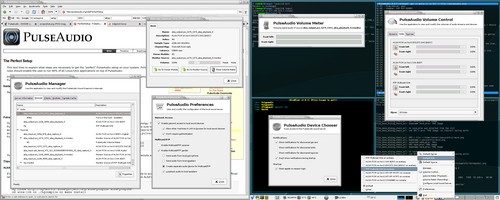
(For the full size image follow this link.)
Distributions
PulseAudio is currently available in the following distributions:
- ALT Linux Sisyphus; for more information, see ALT Linux Sisyphus and PulseAudio (in Russian, only)
- ArchLinux - has a nice Wiki page
- Debian
- Ubuntu (Enabled by default starting from Ubuntu 8.04.)
- Fedora (Enabled by default starting from Core 8)
- Gentoo (Wiki)
- T2 SDE Linux
- Lunar Linux
- Mandriva (Enabled by default in Mandriva 2008.1)
- OpenEmbedded
- OpenSUSE
- Pardus (Enabled by default since Pardus 2008.)
- FreeBSD
- NetBSD (via pkgsrc)
Earlier versions of PulseAudio, then known as Polypaudio, can be found in quite a few distributions: